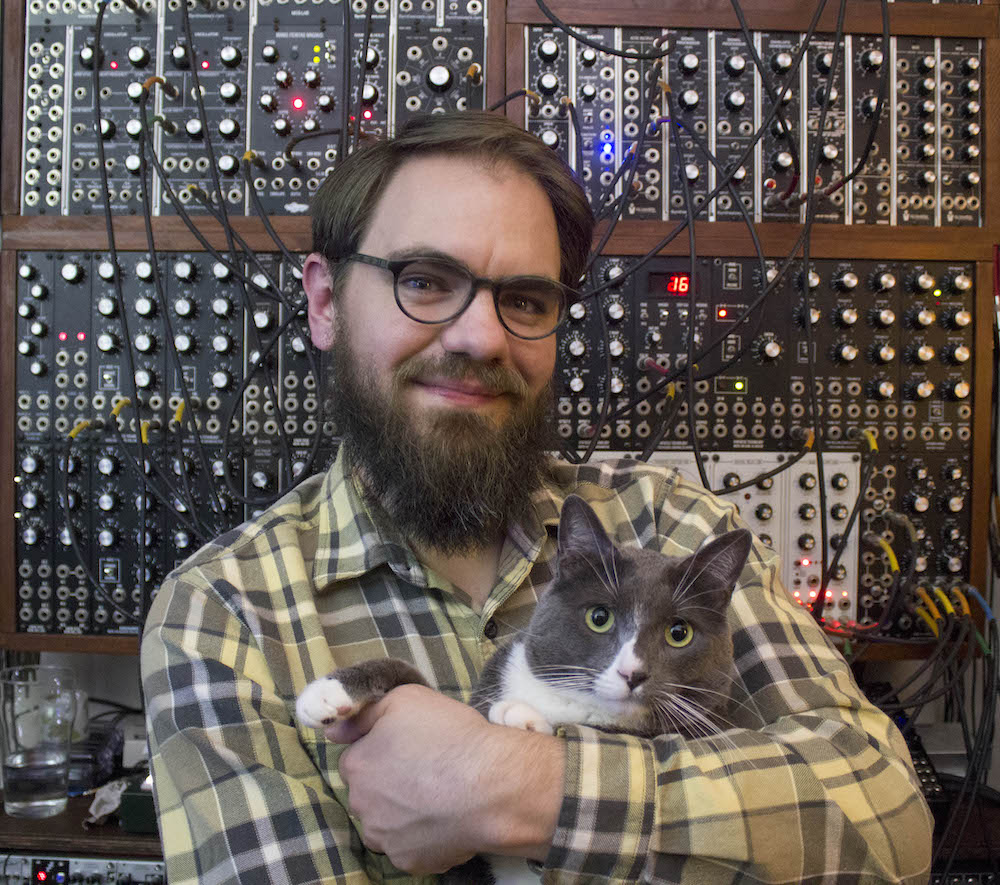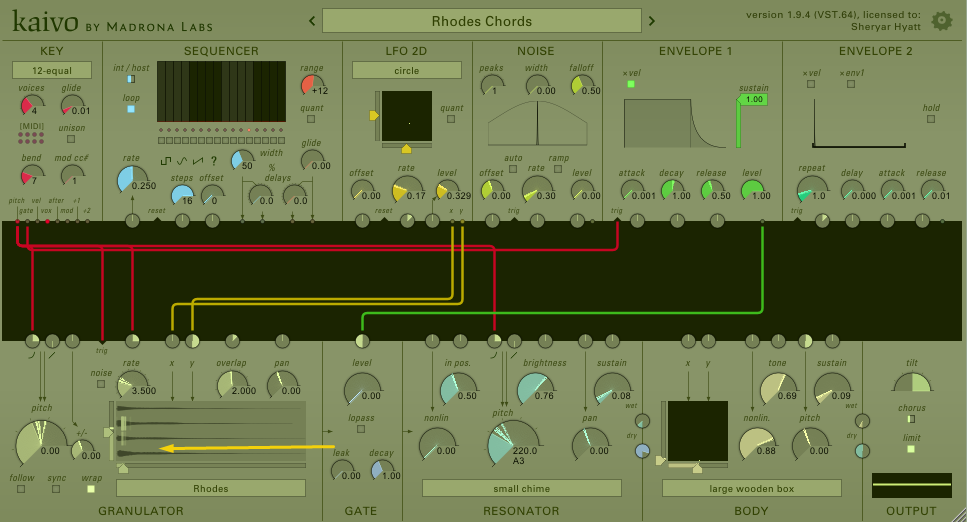
Above you see the 259 Complex Oscillator, which is the closest cousin to Aalto's algorithm from among the Buchla modules. If you want 259 sounds, of course you need to get a 259. It is more complex than my oscillator, both in sound palette and interface. What I tried to do was capture the qualities of its sound that made my ears particularly happy, where that was technically possible in a real-time algorithm. I also took cues from how Buchla's designs do more with less, and distilled the interaction down to make a few knobs that did a lot.
For example, having only one scale control per signal input on Aalto (except for the oscillator pitch) was a conscious decision I made with simplicity in mind. It seems to cover around 90% of the sound making possibilities (designers might call them "use cases") with 50% of the UI.
Who else besides musicians needs precise and intuitive UI? Airplane pilots, that's who. These gauges were another inspiration. Note that when you look at a number, your gaze is also taking in the filled-in area of the dial, not darting back and forth to some number box across the screen. I'm assuming these designers knew what they were doing.
Another musical device that works really well is the Weiss DS1. Note all the breathing room around the knobs. Simple, uncluttered and a joy to use. That it sounds phenomenal doesn't hurt.
Check out the Tone Board for the Yamaha GX1. If you spend your year's development budget making a $60,000 synth, you can put some time into UI. See the clear layout of signal flow and how the knobs connect to it and are grouped by the panel graphics. Also, precise markings in seconds on the sliders as opposed to an arbitrary range of 1-10, or no range at all. If only those drawings of envelope shapes were able to move... you'd have something a lot like Aalto's envelopes. It's no coincidence.
In my view the best way to respect the innovators is to innovate. So instead of trying to reproduce some elusive and hyped "analog magic" I am combining all of the influences above and more into the best design I can make for today's technology. I look forward to sharing this work soon.
Aalto can make many different kinds of sounds, including some that have been difficult or impossible to do with softsynths until now.
Here is a bouncing-ball-style patch made with FM: Aalto FM Bounce by Randy AKA Caro
Here's a clip demonstrating the timbre and waveshape knobs of the complex oscillator. Aalto Timbre+Shape by Randy AKA Caro
MP3s do not compress single-oscillator sounds very well---to say the least! To hear the full-quality sound, use the download links on the Soundcloud players.
Aalto came about because I wanted Soundplane owners to have a rich and expressive sound making tool right out of the box. I designed a small synth that would be easy to learn, easy to use, rich in possibilities, and tightly connected to the controller. Though we still have some work to do on the controller, the synth is nearly done. So we are releasing a MIDI-controlled version of Aalto as an AU and VST plugin this summer.
There's a lot more to say about Aalto, so please stay tuned for more info including a demo movie very soon. If you have questions or suggestions, please visit our forums. I'll post some more info there to get things started.
The Soundplane remains the reason we are doing all of this, and we continue to make progress on it. Brian has recently shifted gears from hardware design to firmware programming. Please check back or subscribe via RSS for an update on the Soundplane A soon!
We have two prototype enclosures milled by O. B. Williams, a local company that mainly does architectural millwork. They have been around since 1890, which makes them one of Seattle's oldest companies. As you can imagine, they know a lot about wood there, about what species to use for different projects, and how to make things that will look great and last. When I visit them I always learn something new.
CNC machines like they are using have made a lot of new designs possible in wood. Look at the beautiful new bikes from Renovo for example. I think we will see lots more innovative products based on this intersection of natural materials and computer-aided manufacturing, and I'm very happy to be making one.
As you can see above, the Soundplane body is milled out of a solid block of wood. A difference from the first prototype is that pegs are left in to hold the circuit board, which means no more messing with plastic standoffs, less assembly time, and lower costs in the long run. There is a back panel (not shown, boring) with a rabbet cut into it that fits snugly into the piece shown. Then the two are screwed together to make a very solid monocoque structure.
As you can see on the front, the unmilled block is actually two blocks glued together down the middle. Why? Two main reasons. The first is mechanical: the composite is less prone to warping than a solid piece of wood. The glue joint is supposed to be stronger than the wood itself, something I look forward to verifying with destructive testing when we are done with our earlier prototype.
The second reason is sustainability: using 4" instead of 8" boards means that a much younger tree can be used. And young alder trees grow very fast. Alder itself has other benefits, including being beneficial for other trees in mixed stands. Find out more courtesy the US Forest Service. Time was, alder was considered a weed tree in our Pacific Northwest, and used for fuel. But for the above and other reasons its popularity as a craft wood is growing. I love its soft glow with a clear oil finish, as shown here, and I hope you'll agree.
Coming soon: more construction details, and our first software synthesizer.
I've recently taken delivery of the flex circuits that are the Soundplane's carrier antennas—basically its only moving parts. There will be four antennas on the Soundplane with 16 carriers each, for a total horizontal resolution of 64 taxels. Here's one of the antennas in closeup.
This was kind of an unusual design because the shapes of the antennas are so critical. Though everyone seems to use it for making PCBs, Eagle would not really, as far as I could tell, have been a good tool for drawing this kind of thing. Adobe Illustrator was, and I already had it. So I looked around for a way to convert Illustrator files to Gerber, which is the format the circuit board people use. I was in luck! Some guy in Seattle had already written a Perl script for this purpose called pdf2gerb. I modified it slightly to output rectangular line ends instead of circular ones, and made some Gerber RS-274X files, hooray. Another open-source tool, gerbv, lets me inspect the Gerber files before I send them off. I was able to get gerbv compiling pretty quickly using Fink on Mac OS X.
Typically, flex circuits are little guys, stuffed into your camera or cell phone. These antennas are considered really big pieces for the process and consequently a little expensive. But flex is the only way I found to reproduce them with the very close tolerances we need. Our prototypes have been made by IPC Calflex in California.
In this picture you can see all the carriers from the top. Instead of the veneer surface we are developing, I have covered the carriers with a matte finish plastic. Now that I see it, I like the look of the Soundplane this way, and I'm guessing that some people will want this as an option.
In the background you can see one of the ubiquitous blue tarps that we Cascadians use as shelter during the winter months.
Here's the flex from the side, bringing the carriers up from under the pickup board that amplifies the received signals and sends them to the DSP. It's a really compact design and there's no way we could have pulled it off without the FFC (flexible flat circuits) and ZIF connectors.
And meanwhile at Brian's, here's the first rev of the DSP board itself, hooked up to a logic analyzer for testing. Our board is based around a Texas Instruments CPU with a combination of high bandwidth and low power. Internal to the Soundplane we have 32 carrier signals and 16 pickups signals all running at around 60 kHz. That's around 50 Mb per second. And amazingly, we will be able to run off USB power if things go according to plan. We have a DC jack on the prototype, in case things don't.
For assembling these boards, we are working with Schippers and Crew here in Seattle. Friendly, fast turnaround, quality work—I've been really impressed. And, their shop is just a short bike ride from my house.
Brian has checked out all of the board's subsystems now, and is making the rev.2 design. When we get those boards back, we can start writing the firmware that will calculate the pressure grids and send them over USB.
The analyzer itself is a pretty cool product. Made by Saleae (which I have no idea how to pronounce), it looks very approachable, but is a powerful tool for the serious hardware hacker. Its software is Windows-only for now, but they claim Mac and Linux support are coming soon.
There are a ton of details, but they are all coming together. The case design is getting a minor revision, and the metal plate that reinforces the USB jack needs to be finalized after the DSP board is finalized. And I'm still working on getting the veneer surface just right, but that's probably another post in itself. Stay tuned for more, including more DIY info and previews of our first synth software, coming soon.
...because you can't plan those moments when things crystallize and sometimes you just have to get out there and do seemingly unrelated things to have them.
At NIME this year, I had the pleasure of hearing a panel of electronic music luminaries agree that pressure-sensitive multi-touch surfaces are an idea whose time has come. So it's a good time to be coming out with our product. But it also means other people will be coming out with similar things.
I think that there's room for multiple products in this market, especially if they are differentiated by technology, price point and aesthetics. One condition that seems required to sustain all of our projects in the long run, though, is a growing pool of people writing music and musical applications for them. At NIME 2009, David Wessel pointed out the brutal truth that "there are a lot of controllers by the side of the road." Most new musical inventions get used mainly by their creators for a while, after which the creators move on to the next thing. This makes sense, because inventors like to invent. But in order for a new instrument to survive, it needs to get into the hands of a critical mass of players and composers. Composers need players. Players need music to play. Sound designers need a variety of rich mappings to start from. All of this activity is mutually sustaining and obviously, the more instruments out there, the better.
So let's recognize that at least a few of us will be making different kinds of the same thing. The only multi-touch, pressure sensitive controller currently available is Haken Audio's Continuum Fingerboard. Most compositions or sound-making tools written for Fingerboard could be played on our Soundplane A and vice versa. And coming soon will be more and probably cheaper controllers based on projects like the IMPAD designed at NYU. Assuming they're big enough, and have a high enough sampling rate, all these instruments can be used to play the same pieces of music.
At the time of the piano's rise in popularity in the late 1700's, a few manufacturers were competing to improve the action. The resulting improvements led to important pieces, particularly Mozart's Piano Concertos. And of course, these pieces led to more pianos being made.
Touch-sensitive surfaces may well become the piano of the 21st century. Because the computer can map flexibly between gesture and resulting sound, mappings can be designed that work for players at different skill levels from beginner to expert. A huge variety of applications are possible, from Guitar Hero-like games to instruments for the virtuoso to sound design tools for film. No one instrument maker is going to write all of these applications. So there's a potential opportunity here for developers, but to be rewarding, the instruments have to be out there.
So: "soundplane." Generic and descriptive. It's made for making sounds (otherwise we wouldn't need a kilohertz sample rate) and it's flat. I hope that more applications and compositions than we can provide are written for soundplanes, and yes, that other people make soundplanes. Really. Our first one, taking a cue from Steinway, is the Madrona Soundplane (model) A. Following our DIY instructions, you can make your own Soundplane 8x8. And so on.
The least modest part of this immodest proposal, my attempt to name this class of instruments, will probably fail. These things arise organically, and are settled on after a long time. Christofori wouldn't have predicted that his gravicembalo col piano e forte would become simply the "piano." But whatever the instruments are called, I know that one of our primary tasks at Madrona Labs is to support the community that will lead to more applications, more compositions, and more people playing music.
Unlike, say, NYU, the environment in Pittsburgh did not have a lot of culinary or cultural distractions nearby. This was both a bad thing and good. Bad, because after finishing making slides at 02:30, being woken up repeatedly by fire alarms at 04:30 and managing to get about thirty minutes more of decent sleep before getting up an hour before my presentation, I found out there was no source of coffee nearby and had to take a 20 minute speed walk to the local coffeeshop. Good, because every single presenter and performer who felt like tying one on after the last night of the conference ended up at the same joint, the fun and sinister Panther Hollow Inn, pictured above.
David Wessel's performance on his Slabs controllers was one of the highlights of the conference. The Slabs are very sensitive multitouch controllers made from multiple touchpads, custom sensing electronics, and a custom-designed FPGA-based brain that provides 96 streams of control data as audio signals. Read the paper. See the video.
Like the Soundplane, The Slabs are a refined multitouch surface—I much admire the obsessive pursuit of control intimacy evident in the work. Their construction as a multiplicity of discrete elements lends itself to really different performance mappings compared to a homogeneous surface. On the Slabs, you are always sure which element you are on, so they seem to lend themselves better to mapping a collection of different voices predictably. Only one finger at a time can be detected on an individual slab, though. So the Soundboard seems better for mapping distinct touches to voices of a synthesizer that can be moved freely across the surface.
On Thursday morning we were treated to a teleconference with three prominent personalities of electronic music: Roger Linn, John Chowning and Max Mathews. Max ate his breakfast wherever he was and interjected just a few words, but really good ones. Linn said that the most crucial area for expressive control lies "in between silence and whispers." This is welcome support for my opinion that signal-based control is going to be a theme of the next generation of interfaces. Everyone seemed to agree that we are seeing the beginning of a renaissance for electronic music, and furthermore that pressure-sensitive multitouch controllers will be important. This gives me comfort that if I'm wrong about this whole thing, at least I'm wrong in the company of some really smart people.
A lot of people came by my demo table and played with the Soundplane 8x8 DIY project. I saw consistent surprise at the sensitivity to touch of what is, electronically speaking, a pretty primitive device. I know, I was surprised too. At least three people seemed quite serious about making their own. I hope they do, and that I can be of help.
The sheets of reinforced, flexible veneer arrived the Monday before the conference, so I managed to get the look-and-feel prototype of the Soundboard together just in time. I'm glad I took the thing out for a show-and-tell at this stage. People really seemed to like the feel of the surface, and on the "what goes on the blank space" question, "nothing" outvoted the next most popular suggestion, "a knob," by 3 to 1.
I seem to be establishing a pattern of going to every other NIME, having hit 2005 and 2007 and 2009. So maybe I'll see you in 2011 in Oslo.
No account yet?
Click "Sign up," above, to set up a New account.
Returning member?
Enter your username and password, then click Login.
If your computer is set up to auto-fill forms, you should just be able to enter your username and type return.
Forgot your password?
Click here and we will